
By: Doggie Utopia Editorial Team | 12 minutes read time
As loving companions, we always want the very best for our dogs. We strive to provide them with happy, healthy lives, filled with joy and comfort. Yet, just like us, our canine friends can face challenges—from anxious moments to achy joints and sometimes even more serious health concerns. In our search for ways to support their well-being, many of us are turning to natural alternatives, and among them, CBD oil has truly captured attention.
It’s completely normal to feel a little curious, maybe even a bit overwhelmed, by all the information out there about CBD for dogs. This guide aims to demystify CBD oil, sharing what we know about how it works, its potential benefits, and how you can approach it as a gentle path to natural wellness for your beloved companion.
What is CBD?
The hemp plant is really rather remarkable, you know. There are more than a hundred different compounds in it, and among them, one of the most fascinating is CBD, or cannabidiol. You have most likely already heard of THC, the substance that causes marijuana’s “high.” The great thing is, though, CBD is quite different. When made correctly, it’s entirely safe for pets and won’t cause intoxication.
How then is CBD oil manufactured? Usually taken straight from the hemp plant, it is then blended with a carrier oil such as coconut or hemp seed oil. The endocannabinoid system (ECS) of your dog may thus profit much from this supplement. Their body’s highly vital system helps control things including their immune responses, mood, sleep, and even pain.
How CBD Oil Could Help Dogs
To really grasp how CBD oil can help our dogs, let’s start with something truly fascinating: the endocannabinoid system (ECS). You know how we humans have all sorts of intricate systems working behind the scenes to keep us feeling good? Well, your dog has something remarkably similar!
Think of the ECS as a tiny, yet incredibly important, internal balancing act. It’s made up of little messengers, or receptors, that are sprinkled throughout their entire body and brain. This system acts like a master conductor for their internal orchestra, constantly working to maintain a state of equilibrium, or homeostasis.
When something feels a little off for your dog—whether it’s discomfort, a bit of anxiety, inflammation, or something else entirely—the ECS steps in to help. Its job is to gently guide things back to normal, promoting balance in various bodily functions. Research highlights the ECS’s crucial role in regulating mood, pain perception, appetite, sleep, and even immune responses in mammals, including dogs.
How CBD Interacts with Your Dog’s ECS

This is where CBD comes into the picture. Cannabidiol (CBD) is a compound found in the hemp plant. Unlike THC, another well-known compound from the cannabis plant, CBD is non-intoxicating, meaning it won’t make your dog “high.” Instead, CBD works its magic by interacting with your dog’s very own ECS.
Specifically, CBD is believed to influence the activity of those tiny receptors we talked about, primarily two main types:
- CB1 receptors: These are found in abundance in the brain and central nervous system. They play a significant role in things like mood, memory, coordination, and how your dog perceives pain.
- CB2 receptors: These are more heavily concentrated in the immune system and peripheral organs and tissues. They are integral to managing inflammatory responses and overall immune function.
While THC directly binds to CB1 receptors, CBD is thought to work in a more indirect way, influencing both CB1 and CB2 receptors and potentially encouraging the body to produce more of its own natural endocannabinoids.
So, rather than just targeting one specific issue like some conventional medicines might, CBD actually gives your dog’s body a gentle boost, helping their own natural system better manage discomfort, stress, and any imbalances. It’s more about encouraging general wellness and supporting their system to operate as it should, rather than simply “curing” a disease.
Potential Benefits: Where CBD May Offer Support
The specific ways CBD oil can benefit your dog will naturally vary depending on their individual needs and circumstances. However, many dog owners and preliminary studies point to several commonly observed areas where CBD may offer valuable support:
1. Easing Stress and Anxiety
It’s heartbreaking to see our dogs distressed. Many pups experience anxiety, whether it stems from separation when you leave the house, the booming sound of fireworks or thunderstorms, or even the stress of vet appointments and car rides. This is often one of the first areas where people explore CBD for their dogs.
One study found that dogs exhibiting anxiety behaviors showed reduced stress when treated with a CBD source. Further research has shown that a daily dose of CBD significantly reduced stress measures in dogs during repeated exposure to car travel, with effects persisting over a six-month period. This suggests CBD might help anxious dogs settle into happier routines, both situationally and over the long term.
2. Supporting Joint Comfort and Mobility
As dogs get older, or if they’re dealing with conditions like arthritis, joint pain can really put a damper on their zest for life. The anti-inflammatory qualities often attributed to CBD have garnered significant interest in this area.
Studies published in Frontiers in Veterinary Science have indicated that CBD greatly enhanced comfort and movement in dogs with osteoarthritis. This suggests CBD could be a valuable addition to their wellness routine, helping to reduce pain and improve mobility, allowing them to enjoy their walks and playtime more comfortably.
Another systematic review and meta-analysis also suggested that oral full-spectrum CBD oil might reduce pain severity and interference scores in dogs with osteoarthritis.
3. Reducing Seizure Frequency
For dogs living with epilepsy, the possibility of reducing seizure frequency is a huge area of hope. CBD has shown promise in this challenging condition. The American Kennel Club Canine Health Foundation, in collaboration with Colorado State University, has even sponsored research on the use of CBD for canine epilepsy, with early findings appearing promising.
Another study reported that 89% of dogs receiving CBD in a clinical trial experienced a reduction in seizure frequency. This ongoing research is incredibly important and offers a beacon of hope for dogs and their families.
3. Encouraging Appetite and Addressing Nausea
When a dog is feeling unwell, a common side effect can be a loss of appetite or bouts of nausea. This can be particularly concerning for pets recovering from illness, undergoing treatments, or simply experiencing digestive upset. Another study suggests that CBD may help stimulate appetite and reduce nausea and vomiting in dogs.
Choosing a Safe and Effective CBD Oil for Your Dog

As with any supplement, selecting a high-quality product is absolutely crucial. The CBD market can be a bit like the Wild West, so knowing what to look for will help you make a confident choice for your dog.
✅ Look for a Certificate of Analysis (COA) from a Third-Party Lab
This is non-negotiable. A reputable CBD company will have their products tested by an independent third-party laboratory. The COA proves that the product contains the amount of CBD advertised and, more importantly, that it’s free from harmful contaminants like pesticides, heavy metals, residual solvents, and excessive THC. Always check the COA to ensure the THC content is below the legal limit of 0.3%.
✅ Opt for Organic, U.S.-Grown Hemp
Hemp grown in the U.S. is generally subject to stricter agricultural regulations. Organic certification further ensures the absence of pesticides and other chemicals that could be harmful to your dog.
✅ Choose Full-Spectrum or Broad-Spectrum CBD
Full-spectrum CBD contains all the naturally occurring compounds in the hemp plant, including other cannabinoids, terpenes, and flavonoids, along with trace amounts of THC (less than 0.3%). This creates an “entourage effect,” where these compounds work synergistically to enhance the overall benefits.
Broad-spectrum CBD contains a similar array of compounds but has had the THC completely removed. This is a good option if you prefer to avoid THC entirely.
Avoid “CBD isolate,” which is pure CBD with no other beneficial compounds.
✅ Consider the Extraction Method
CO₂ extraction is generally preferred as it is a clean, safe, and efficient method that doesn’t involve harsh chemical solvents.
✅ Check the Carrier Oil
CBD oil is typically suspended in a carrier oil. MCT oil (medium-chain triglyceride oil, often derived from coconut) is a popular and generally safe choice for dogs, as it can aid in absorption.
✅ Read Reviews and Research the Brand
Look for brands with a strong reputation, transparency about their sourcing and manufacturing processes, and positive customer feedback.
✅ Dosing and Administration: Finding the Right Balance
Determining the right CBD dosage for your dog is a very individual process. There’s no universal “correct” dose, as it depends on factors like your dog’s weight, the severity of their condition, their individual metabolism, and the concentration of the CBD product.
General guidelines often suggest starting with a low dose (e.g., 0.1-0.2 mg of CBD per pound of body weight) and gradually increasing it until you observe the desired effects. It’s always best to start low and go slow. Many products will provide dosing charts based on weight, but these are just starting points
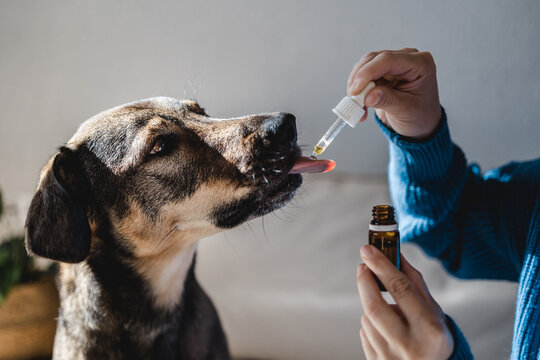
A good practice is to administer CBD twice a day, roughly 12 hours apart, to maintain a consistent level in their system. You can offer the oil directly into their mouth (many dogs don’t mind the taste, especially if it’s flavored), mix it with their food, or drop it onto a favorite treat. Observing your dog closely is key to assessing the oil’s effectiveness; look for changes in their behavior, comfort level, and overall demeanor. Keeping a detailed journal can be very helpful in tracking progress.
Top CBD Oil Brands for Dogs
🌿 Holistapet
One very reliable brand providing full-spectrum CBD oil created especially for animals is Holistapet. A dog’s weight determines the potency of their oils; their products are completely non-GMO, organic, and lab-tested. For discriminating eaters, Holistapet also provides CBD snacks and pills.
Why it stands out:
- Full-spectrum CBD with added superfoods
- Designed specifically for dogs, cats, and horses
- Subscription discounts and detailed dosage guides
🌱 Bailey’s CBD Oil
Another great option is Bailey’s, particularly noted for their veterinary-formulated CBD oils. Their goods are produced from USDA organic hemp, and they provide thorough batch lab findings.
Why it stands out:
- Created in partnership with a veterinarian
- Sustainably grown and sourced in the U.S.
- Offers bacon-flavored oils and treats
4. How to Give CBD Oil to Dogs
There are several ways one might use CBD oil:
- Directly in the mouth: Quicker absorption is possible, especially under the tongue.
- Mixed with food: Though it might take a little longer to absorb, many dogs find their CBD more readily this way.
- In treats or capsules: Ideal for dogs with delicate palates or who object to oils, treats or pills
You usually start with a low dose—typically 0.25 mg per pound of body weight—and then progressively increase it based on the dog’s reaction. Most companies contain dose guidelines based on the weight of the dog and degree of symptoms.
Potential Side Effects and Safety Considerations

While CBD is generally considered safe and well-tolerated in dogs, especially when using high-quality products, it’s essential to be aware of potential side effects, although these are usually mild and temporary:
- Drowsiness or Lethargy: This is often the most common side effect and typically indicates that the dose might be too high. Adjusting the dosage downwards usually resolves this.
- Dry Mouth: CBD can temporarily decrease saliva production, which might lead to increased thirst. Ensure your dog always has access to fresh water.
- Gastrointestinal Upset: Some dogs might experience mild diarrhea or an upset stomach, often due to the carrier oil or if the dose is too high initially. Starting with a very small dose and gradually increasing it can help prevent this.
- Liver Enzyme Elevation: Some studies, particularly at higher doses, have noted elevations in a particular liver enzyme (alkaline phosphatase). While this isn’t always indicative of liver damage, it underscores the importance of discussing CBD use with your veterinarian, especially if your dog has any pre-existing liver conditions or is on other medications.
Crucially, always consult with your veterinarian before introducing CBD oil to your dog, especially if they are currently on any other medications or have underlying health conditions. Your vet can provide personalized advice, help you determine the appropriate dosage, and monitor for any potential interactions or adverse effects. They are your best resource for ensuring CBD is a safe and beneficial addition to your dog’s health regimen.
The Future of CBD for Canine Wellness
The interest in CBD oil for dogs continues to grow, and so does the scientific research surrounding it. While many of the studies so far are preliminary, they paint a promising picture of CBD’s potential to enhance the quality of life for our canine companions. As more robust and large-scale clinical trials emerge, our understanding of CBD’s full benefits and optimal uses will only deepen.
Final Thoughts

For many dog owners, CBD has become a valued part of their approach to natural wellness, offering a gentle way to support their dogs through various challenges and to foster a more comfortable, balanced, and joyful life. By staying informed, choosing high-quality products, and working closely with your veterinarian, you can explore whether CBD oil is the right step towards natural wellness for your cherished dog.

 Doggie Utopia
Leave a comment